
For years, many health plans could count on a significant percentage of their ACA members renewing coverage with little or no action required. While annual notices, plan updates, and regulatory communications remained important, passive renewal helped smooth the path to retention.
That landscape is changing.
As CMS continues to strengthen Marketplace integrity, increase eligibility verification requirements, and move toward more active consumer participation in the renewal process, retaining ACA members is becoming less of an operational exercise and more of a health plan marketing and member engagement challenge.
The plans that succeed in the coming years will not simply offer competitive products. They will be the plans that make renewal easy to understand and easy to complete.
The Shift Away from Passive Renewal
Recent CMS rulemaking and Marketplace policy changes reflect a growing emphasis on enrollment accuracy and consumer engagement. Policymakers have expressed concerns that automatic renewals can perpetuate outdated eligibility information, inaccurate subsidy determinations, and coverage selections that no longer align with a member’s needs.
As a result, consumers are expected to play a more active role in maintaining their coverage. Future enrollment periods will likely require more member interaction, more verification activities, and more decision-making than many consumers have experienced in the past.
While these changes are intended to improve program integrity, they also introduce a new challenge for health plans: consumer friction.
Compounding these challenges is the possibility that the federal Marketplace Open Enrollment Period may close on December 15 beginning with the 2027 plan year. If finalized, consumers would have less time than ever to review options, verify eligibility information, and complete enrollment actions.
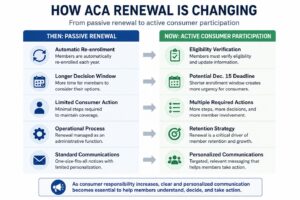
Every Additional Step Creates Friction
In marketing, friction is anything that makes it harder for a consumer to complete a desired action. Research from Health Management Associates has warned that Marketplace consumers face increasing complexity as they navigate subsidy changes, eligibility requirements, plan comparisons, and renewal decisions. For ACA members, friction can include:
- Understanding changes to subsidies or premiums
- Verifying eligibility information
- Reviewing plan changes
- Comparing alternative coverage options
- Meeting enrollment deadlines
- Completing required documentation
While each step may seem manageable on its own, the cumulative effect can overwhelm consumers who are already navigating work, family obligations, healthcare needs, and financial pressures.
The result is predictable. The more complicated the process feels, the greater the risk that consumers delay action, make poor decisions, or fail to complete the renewal process altogether.
Health plans can no longer assume that members will successfully navigate these requirements on their own.
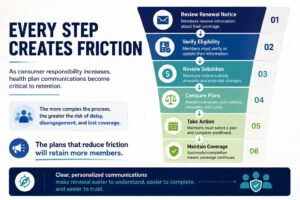
Every step in the journey causes friction
CMS Communications Serve a Different Purpose
Marketplace notices and regulatory communications play an essential role in the enrollment process. They satisfy compliance requirements and provide consumers with important information regarding their coverage and eligibility.
However, compliance communications are not designed to drive retention.
They are not intended to reinforce the value of a health plan’s network, benefits, care management programs, digital tools, customer service experience, or overall member experience. Nor are they designed to simplify complex decisions or provide personalized guidance.
In other words, CMS communications tell members what is happening.
Health plan communications help members understand what it means.
That distinction is important.
Renewal Is No Longer Just an Operations Function
Historically, many organizations viewed renewal communications as an administrative requirement. The goal was to distribute required materials and satisfy regulatory obligations.
Today’s environment demands a different approach.
As consumer action requirements increase, renewal communications become one of the most important member retention and health plan marketing tools available to a payer organization.
Effective renewal campaigns help members:
- Understand enrollment deadlines and required actions
- Understand plan changes
- Assess the impact of premium adjustments
- Evaluate subsidy implications
- Confirm provider network participation
- Complete required actions on time
- Feel confident in their coverage decision
Most importantly, they reduce uncertainty.
Consumers who understand their options are more likely to remain engaged. Engaged members are more likely to renew.
The Opportunity for Health Plans
The good news is that health plans have an opportunity to differentiate themselves.
While every carrier must comply with the same regulatory requirements, not every carrier will invest in creating a simple, personalized renewal experience.
The organizations that treat renewal as a member engagement strategy and not simply a compliance exercise will be better positioned to retain members, reduce confusion, and strengthen member relationships.
During one of the most disruptive enrollment periods in Marketplace history, a regional health plan supported by Direct Choice achieved an 87% retention rate through a coordinated strategy that combined personalized direct mail, targeted email communications, simplified decision support, and proactive member outreach.
While no two markets are identical, the experience demonstrates that clear, consumer-focused communications can play a critical role in helping members successfully navigate renewal.
As passive renewal declines, retention will increasingly depend on a member’s ability to successfully navigate the renewal process. Health plans that help members understand what to do, when to do it, and why it matters will have a distinct competitive advantage.
Looking Ahead
The ACA Marketplace continues to evolve. Regulatory changes, eligibility verification requirements, and shifting consumer expectations are reshaping the enrollment experience.
The plans that thrive in this environment will recognize a fundamental truth:
Retention is no longer just a product challenge or a compliance challenge.
It is a communication challenge.
And the organizations that simplify the renewal experience will be the ones most likely to keep the members they worked so hard to earn.
A Shorter Enrollment Window Raises the Stakes
For the first time in ACA Marketplace history, federal policymakers are considering a return to a December 15 Open Enrollment deadline. Combined with increased eligibility-verification requirements and growing consumer responsibility during renewal, health plans may have less time than ever to help members make informed coverage decisions.
Research from Health Management Associates warns that consumers will need to actively review coverage options, understand subsidy impacts, and take action to maintain coverage. At the same time, KFF research found that recent Open Enrollment periods left many Marketplace consumers feeling worried and frustrated as they navigated plan choices and affordability concerns.
For health plans, the implication is clear: waiting until Open Enrollment begins may be too late. Renewal communications must start earlier, be highly personalized, and clearly explain what members need to do, when they need to do it, and why it matters.
Health plans spend millions of dollars each year acquiring Marketplace members. As passive renewal gives way to active consumer participation, retaining those members may increasingly depend on the effectiveness of a plan’s communication strategy rather than the strength of its product alone.
Health plan marketing strategies that win in 2027 and beyond may not necessarily focus on the lowest premiums or the broadest networks. They will be the strategies that use clear, personalized member communications to make renewal easy to understand, easy to complete, and easy to trust.
— Beth Harvath, Director of Marketing Account Services, Direct Choice
Beth has spent more than 16 years helping health plans improve acquisition, onboarding, engagement, and retention through data-driven multi-channel communications strategies.
Have Questions?
CONTACT US!