
In our previous article, The End of Passive Renewal: Why ACA Member Retention Is Becoming a Marketing Challenge, we explored how changing CMS requirements and increased consumer responsibility are reshaping the ACA renewal landscape.
The next question is even more important:
How should health plans respond?
The instinctive answer is often “send more communications.”
The better answer is to design a better renewal experience.
As CMS increases eligibility verification requirements, consumers take a more active role in maintaining coverage, and the federal Marketplace potentially returns to a December 15 Open Enrollment deadline, health plans have less time to help members make informed decisions.
Recent KFF research underscores the stakes. Eight in 10 returning Marketplace enrollees reported higher healthcare costs in 2026. Nearly three in 10 switched Marketplace plans, while 9% of those who had Marketplace coverage in 2025 reported being uninsured in 2026. Cost was a major factor in many of those decisions.
Health Management Associates and Wakely have similarly warned that rising costs, regulatory changes and shifting plan options can increase consumer confusion and coverage loss. Their research reinforces the need for direct, succinct and repeated multichannel communications that clearly explain what has changed and what action consumers need to take.
The challenge isn’t simply communicating more.
It’s helping members navigate an increasingly complicated process with confidence.
The Most Overlooked Challenge in ACA Renewal Communications
Health plans face a challenge that is especially pronounced in the Individual Marketplace: members can enroll and renew through multiple channels.
Unlike Medicare Advantage or employer-sponsored coverage, ACA members don’t all follow the same enrollment path.
One member may have originally enrolled directly through the carrier.
Another may have enrolled through HealthCare.gov.
Others may use a state-based Marketplace.
Many work with licensed brokers.
Others return to the same broker who completes enrollment through HealthSherpa or another Enhanced Direct Enrollment platform.
From the member’s perspective, none of these distinctions matter.
They simply want to know one thing:
“What do I need to do to keep my coverage?”
Unfortunately, that’s not always an easy question to answer.
A health plan may know how a member previously enrolled, but it cannot assume the member will choose the same path at the next renewal period. A member who enrolled directly last year may decide to work with a broker this year. Another may begin shopping on HealthCare.gov before deciding to return directly to the carrier.
That uncertainty creates one of the biggest communication challenges of Open Enrollment.
How do you simplify the renewal experience when the next step isn’t the same for every member?
Stop Directing Members. Start Navigating Them.
Many renewal communications focus on telling members where to renew.
That’s becoming increasingly difficult in today’s Marketplace.
Instead, health plans should focus on helping members determine how they should renew.
Rather than assuming a single enrollment path, communications should acknowledge the choices available and help members identify the option that’s right for them.
Instead of saying:
“Renew your coverage here.”
Consider guiding members with language like:
- If you enrolled directly through our health plan…
- If you enrolled through HealthCare.gov…
- If you worked with a broker…
- If you’re unsure how you enrolled last year…
That subtle shift reduces confusion without forcing members into the wrong process.
Every Communication Should Lead to One Place
One of the biggest opportunities for health plans is creating a single renewal destination.
Not an enrollment system.
A navigation experience.
Every communication—including the renewal kit, email reminders, QR codes, digital advertising, customer service scripts, and outbound calls—should point members to the same landing page.
The landing page doesn’t need to ask members to enroll immediately.
Instead, it should answer the question every member is asking:
“Where do I begin?”
Imagine a simple guided experience:
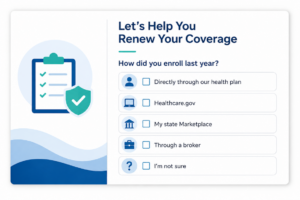
Each response guides the member toward the appropriate next step, whether that’s logging into the Marketplace, contacting their broker, renewing directly with the carrier, or speaking with customer service.
Rather than expecting members to understand the complexities of ACA enrollment, the health plan becomes their guide.
Separate Education from Enrollment
Another common mistake is trying to accomplish everything in one communication.
A renewal packet shouldn’t attempt to explain every possible scenario.
Instead, each communication should have one clear objective.
Think of the renewal experience as three distinct phases:
Phase 1: Awareness
Help members understand that renewal is approaching and explain what’s changing.
Phase 2: Navigation
Help members determine which renewal path is appropriate for their situation and answer common questions before they begin.
Phase 3: Enrollment
Guide members to the appropriate enrollment channel with confidence.
Each phase builds upon the previous one.
The result is a simpler experience that reduces confusion while supporting whichever enrollment path the member ultimately chooses.
A Communication Timeline That Supports Decision-Making
Many renewal campaigns begin when Open Enrollment starts.
By then, valuable time has already been lost.
Instead, health plans should think about communications as a journey that begins well before November 1.
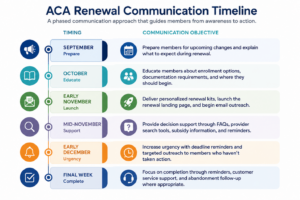
This approach transforms renewal from a compliance event into a guided member experience.
Designing for Confidence
Health plans invest significant resources in acquiring Marketplace members.
As members face more reasons to actively review their eligibility, costs and plan options, retention will increasingly depend on making renewal easier—not simply reminding members to act.
The most successful health plan communications strategies won’t be defined by the number of emails sent or the size of the renewal package.
They’ll be defined by how effectively they remove friction, answer questions before they’re asked, and guide members toward the right next step.
Health plans can’t control every aspect of the ACA renewal process.
But they can control how easy they make it for members to navigate.
And in a Marketplace where consumer confidence may be the difference between renewing and dropping coverage, that may become one of the most valuable competitive advantages a health plan can build.
Turn Renewal Communications Into a Connected Member Experience
Building an effective ACA renewal experience requires more than a compliance notice. It requires coordinated messaging, data-informed segmentation, intuitive navigation tools and a communication cadence designed around the decisions members must make.
Direct Choice helps health plans create integrated renewal communications that reduce confusion, support member decision-making, and move consumers from awareness to completed enrollment. Click Contact us below to discuss how your renewal communications can work together as a single, connected member journey.

Beth Harvath, Director of Marketing Account Services, Direct Choice
Beth has spent more than 16 years helping health plans improve member acquisition, onboarding, engagement, and retention through data-driven, multichannel communications strategies.